Dog-Dun-It is a card game that was made with the idea that people could have fun while acting like something they are not. Through this idea, Dog-DUn-It became a reality in which people like you and me can have fun and enjoy our time with family and friends. Either during the Holidays or during vacation.
Dog-Dun-It for those of you who are not familiar with this game. It is a game that 3 players play. One player will play the judge while the other two players will play the defendant and prosecution. Either side will have to present their arguments by either acting like the dog hey were assigned through the card they got. Or by doing weird challenges that have been given to them in said card.4
From Prototype to Finished Product
1.Prototype
The original idea for our game was that players should have the ability to have a physical board which was set up in a Japanese courthouse style. Once the game began, the judge, defendant, and prosecutor would use game pieces that represented them respectively to move from their default position to the front of the “court.” Which was represented through a big circle at the top of the board game.
After either side had presented their argument and had finished moving their pieces from their default position to the front and back. The judge would then move their piece to their respective position and decide who had won the argument for the round.
After the decision has been made by the judge, the winning side would then get a “treat” from the Judge. In the prototype, the treat would be represented by a golden coin.
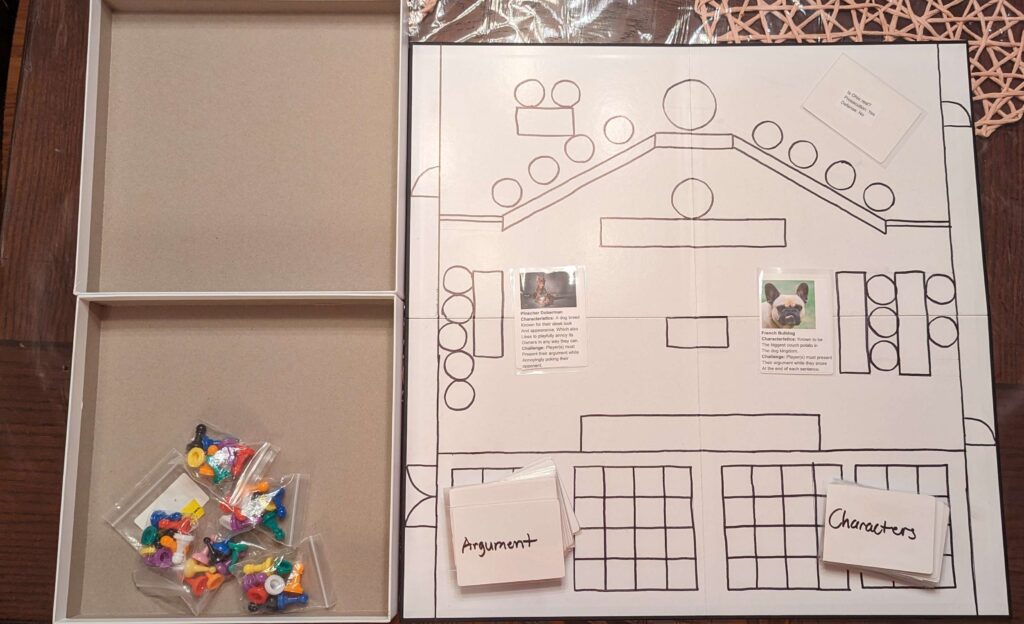
In the prototype that you can see above, you are able to appreciate the Japanese court layout we originally chose. The game pieces that we thought we were going to be using. And the coins that represented the “Treats” players got after winning a round.
2. Play-testing Results
So, for our play testing, we as a group decided that we would do it individually. Not only did this allow us to be personally close to our play-testing subject. But we were also able to get valuable feedback without making them feel overwhelmed and overstimulated.
When we began our play-testing session, there was one thing that we found out very quickly.
That was that our original idea of having a board that had a visual representation of a course on the table was not a good idea because players didn’t see the need to have a board between them. Since most players played the game by just looking at the cards and not looking at the board we created.
Another aspect that we decided on was that the winning condition of the game should have been that whoever reaches ten points first wins the game. During our play testing sessions, our game testers complained a lot about the fact that the winning condition made the game take longer to finish than it should have.
Lastly, one of the things that stood out to us once we discussed our results as a team together was that there was a varied opinion on how long people should have to discuss their starting arguments at the beginning of each round. Some people said that the time limit should be reduced from 1 minute to 30 seconds. Other people have also said that it should be increased to 1 minute and 15 seconds. And others have said that it should just stay the way it is.
3. Results and Final Version of The Game
After having discussed our findings as a team. We got together and finally decided on what things should be included, what should be taken out, and what should be changed in the final iteration of the game.
The first decision that we made as a team was that the time that each side should have to present their argument should be reduced from 1 minute to 45 seconds. The second change we decided to make was that we were going to completely take the board out of the game because people saw it as a waste of space and thus was unnecessary to play the game as a whole. The third change we made for the game was that we reduced the winning condition from 10 points to just 5 points. We decided to implement these changes because they allowed the game to progress at a faster rate. But it also allowed people to have fun and be able to enjoy the game without having to wait a long time for it to finish or go into the next round.
In conclusion, our game ended up being a board game into a card game that can be enjoyed by anyone at any time. Which not only fulfilled our goal of making a game accessible to as many people as possible. But, it helped us learn along the way how people react to our ideas and how we should approach the challenge of making something that is not only enjoyable but also accessible.
Lastly, below you’ll see apicture of the finish product that me and the three partners that I had the pleasure to work with made and released internally in our school.
P.S. – All creative credits go to Emily Duff for being the graphic designer for our game. The story boarding and character creation goes to David Nelson. And the design for the prototype and creation of it goes to Francisco R. Galvan and yours truly, Bryan M, Guzman
Socials: